Comparing 450W vs 550W solar panels helps you choose modules that suit your roof, target system size, and inverter specifications.
Both are suitable for residential solar installations, but they differ in rated power output, physical dimensions, electrical specifications, and the number of panels needed to reach a target system capacity.
A 550W solar panel produces approximately 22% more rated power than a 450W panel under standard test conditions. However, that does not automatically make it the better choice for every Philippine home.
Larger panels may reduce the number of modules and mounting components required, but smaller panels can be easier to arrange on roofs with limited or irregular space.
This guide compares 450W and 550W solar panels based on electricity generation, roof space, installation requirements, cost, and compatibility with common solar inverters.
In this guide
What is the difference between 450W and 550W solar panels?
The primary difference is their rated maximum power output under standard test conditions (STC).
A 550W panel has 100W more rated capacity than a 450W panel.
However, actual electricity generation depends on sunlight, temperature, shading, panel orientation, and the efficiency of the overall solar system.
450W vs 550W solar panels: comparison table
| Feature | 450W panel | 550W panel |
|---|---|---|
| Rated maximum power | 450W | 550W |
| Relative power output | Baseline | 22.2% higher |
| Physical dimensions | Model-dependent | Often larger |
| Module weight | Model-dependent | Often heavier |
| Panel count for 4kWp or more | 9 panels (4.05kWp) | 8 panels (4.4kWp) |
| Rooftop layout | May offer more flexibility | Depends on roof geometry |
| Price per panel | Often lower | Often higher |
| Price per watt | Depends on actual quotation | Depends on actual quotation |
Panel wattage alone does not determine module efficiency, durability, or long-term value.
A premium 450W panel may outperform a lower-quality 550W panel in certain conditions, particularly when comparing temperature behavior, degradation, warranty coverage, and installation constraints.
How much electricity can a 450W solar panel generate?
To estimate daily electricity production, multiply the panel’s rated capacity by peak sun hours and an overall system performance factor.
For our Philippine examples, we will use:
- Peak sun hours: 4.5 hours per day
- Performance factor: 80%
- No significant shading
- Suitable panel orientation
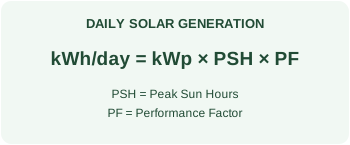
For a 450W panel:
0.45 × 4.5 × 0.80 = approximately 1.62kWh per day.
Over a 30-day month, this is approximately 48.6kWh.
These are modeled averages, not guaranteed production figures.
How much electricity can a 550W solar panel generate?
Using the same assumptions:
0.55 × 4.5 × 0.80 = approximately 1.98kWh per day.
Over 30 days, this is approximately 59.4kWh.
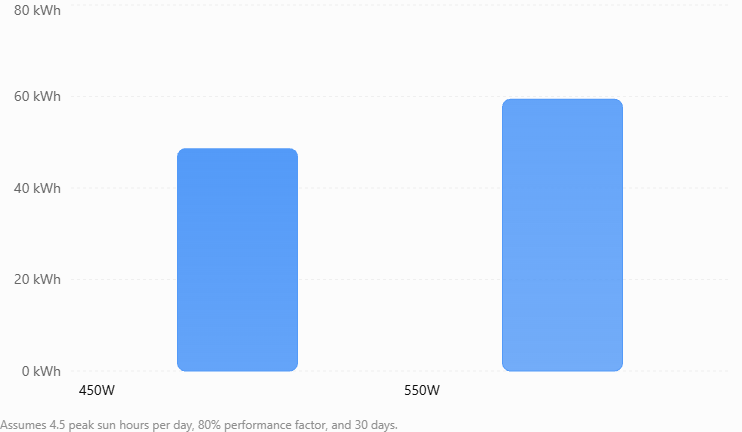
Under identical conditions, a 550W panel could generate approximately 10.8kWh more electricity per month than a 450W panel.
The difference becomes more significant when comparing multiple panels across an entire installation.
How many 450W or 550W panels do you need?
The number of panels depends on your target solar array capacity.
| Target capacity | 450W panels | 550W panels |
|---|---|---|
| At least 2kWp | 5 | 4 |
| At least 3kWp | 7 | 6 |
| At least 4kWp | 9 | 8 |
| At least 5kWp | 12 | 10 |
| At least 6kWp | 14 | 11 |
| At least 8kWp | 18 | 15 |
The panel counts are rounded up to reach or exceed each target.
Actual array capacity will differ slightly because panels are installed in whole units.
For example, a 5kWp target can be exceeded using either twelve 450W panels (5.4kWp) or ten 550W panels (5.5kWp).
Which panel requires more roof space?
A 550W panel is often physically larger than a 450W panel, but the exact difference depends on the manufacturer and module design.
For illustration, consider:
| Specification | Example 450W | Example 550W |
|---|---|---|
| Panel length | 1.76m | 2.28m |
| Panel width | 1.13m | 1.13m |
| Approximate area | 1.99m² | 2.58m² |
| Panels for at least 5kWp | 12 | 10 |
| Combined module area | 23.9m² | 25.8m² |
These dimensions are illustrative rather than specifications for particular products.
In this example, the 450W modules actually require slightly less combined panel surface area to exceed 5kWp.
This demonstrates why higher wattage does not automatically mean better roof-space efficiency.
The more meaningful specification is module efficiency, measured as the percentage of incoming solar energy converted into electricity under standard test conditions.
Roof layout also matters. A smaller module may fit around roof obstructions where a larger module cannot.
Are 550W solar panels more efficient than 450W panels?
Not necessarily.
Solar panel efficiency is different from rated wattage.
A 550W panel may produce more electricity because it has a larger surface area, not because its solar cells convert sunlight more efficiently.
For example, two panels could both have approximately 21% efficiency while having different physical sizes and rated outputs.
When comparing products, review the manufacturer’s module efficiency, temperature coefficient, power warranty, and degradation specifications.
Which solar panel performs better in Philippine heat?
Both 450W and 550W panels lose output as cell temperature rises.
Solar modules are rated under standard test conditions that include a cell temperature of 25°C. In actual Philippine rooftop installations, solar cell temperatures can become significantly higher.
The panel’s temperature coefficient indicates how much its power output changes with temperature.
For example, a panel with a temperature coefficient of -0.35% per °C would experience an estimated 12.25% reduction in rated output at a cell temperature of 60°C, assuming the coefficient applies linearly.
A panel with a better temperature coefficient may retain more output under hot conditions.
Therefore, when comparing panels for Philippine installations, temperature performance is often more useful than comparing wattage alone.
Can you use 450W or 550W panels with a 3kW solar inverter?
Potentially, yes.
The correct panel configuration depends on the inverter’s PV input specifications, not simply its 3kW AC output rating.
For example, six 550W panels provide 3.3kWp of rated solar capacity.
However, you must check:
- Maximum supported PV array power
- MPPT operating voltage range
- Maximum PV open-circuit voltage
- Maximum input current and short-circuit current
- Number of MPPT trackers and supported string configurations
- Temperature-adjusted string voltage limits
A solar inverter with a 3kW AC rating may support a PV array larger than 3kWp, but this must be confirmed from its datasheet.
Never connect panels based solely on matching total wattage.
Can you mix 450W and 550W solar panels?
Mixing different solar panel wattages is technically possible in some configurations, but it requires careful electrical design.
Panels connected in series carry the same string current. Mismatched current characteristics can reduce the output of the string.
Panels connected in parallel must have compatible operating voltages.
Using separate MPPT inputs or appropriate power electronics can sometimes accommodate different panel types.
For most new residential installations, using matching solar panels within each string is the simpler and more predictable approach.
Which is more affordable: 450W or 550W?
The better comparison is the cost per watt rather than the price per panel.
Suppose two hypothetical solar panels are priced as follows:
| Panel | Example price | Price per watt |
|---|---|---|
| 450W | ₱3,600 | ₱8.00/W |
| 550W | ₱4,125 | ₱7.50/W |
In this example, the 550W panel offers a lower purchase price per watt.
However, these are hypothetical figures, not verified Philippine market prices.
Installation costs, mounting requirements, shipping, warranty support, and panel availability can affect the overall value.
Formula: Solar panel price per watt
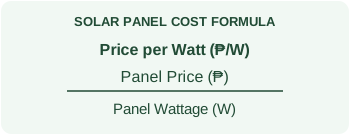
For the best buying decision, compare complete installed system quotations rather than individual panel prices alone.
Which solar panel should Philippine homeowners choose?
For a new residential solar installation, 550W panels can be attractive when the roof layout accommodates their dimensions and the cost per watt is competitive.
They can reduce the total number of modules needed to reach a target system capacity.
However, 450W panels remain useful for roofs with limited usable sections, complex layouts, or installations where smaller module dimensions provide a better fit.
Choose 550W panels when
You have sufficient uninterrupted roof space, compatible inverter inputs, and a competitive installed cost per watt.
Choose 450W panels when
Smaller dimensions improve roof coverage, installation access, or compatibility with the planned array configuration.
Frequently asked questions
Is a 550W solar panel better than a 450W panel?
A 550W panel provides more rated power per module, but it is not automatically more efficient or cost-effective. Compare module dimensions, efficiency, temperature coefficient, warranty, and installed price per watt.
How many 550W solar panels do I need for a 5kW system?
Ten 550W panels provide 5.5kWp of rated solar capacity. Whether this is appropriate depends on the inverter’s supported PV input and the system design.
Can a 550W solar panel charge a 100Ah battery?
Yes, with a compatible solar charge controller or inverter. Charging performance depends on the battery voltage, solar production, controller capacity, and charging limits.
Can a 550W solar panel run an air conditioner?
A single 550W panel generally cannot reliably supply a typical 1HP air conditioner by itself. Multiple panels and a suitable inverter are normally required, with batteries or grid support depending on operating conditions.
Do 550W solar panels generate 550W all day?
No. The 550W rating is measured under standard test conditions. Actual output varies throughout the day with irradiance, temperature, shading, and other factors.
Are 450W solar panels outdated?
Not necessarily. A 450W panel can still be suitable for residential solar installations, particularly when its efficiency, warranty, dimensions, and price match the project requirements.
Final verdict
For many new Philippine residential solar installations, 550W panels are a practical choice when the roof has sufficient space and the modules offer competitive cost per watt.
However, 450W panels may provide better flexibility for smaller or irregular roof layouts.
Instead of choosing based on wattage alone, compare module efficiency, physical dimensions, temperature performance, inverter compatibility, warranty, and total installed cost.
The best solar panel is the one that delivers the most useful energy and long-term value for your specific installation.
Continue with our solar panel calculator, household solar panel sizing guide. Use the examples to compare assumptions before requesting a site-specific design.
For background on rooftop suitability, system planning, and choosing an installer, see the U.S. Department of Energy’s Homeowner’s Guide to Solar. It covers general planning principles; Philippine tariffs and utility requirements differ.