How Many Solar Panels Do You Need to Power a House in the Philippines?
Work out how many solar panels your Philippine home needs. Follow five steps using electricity consumption, peak sun hours, losses, and panel wattage.
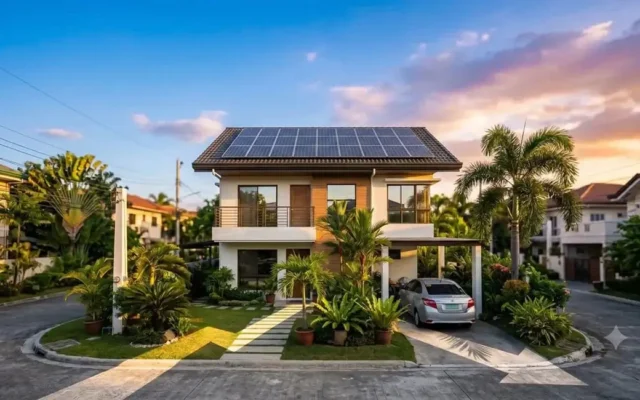
Illustrative solar-home concept
TOOLS FOR THE NUMBERS
Estimate battery runtime, solar panel requirements, and inverter capacity using our practical solar calculators.
Estimate how long your LiFePO4 battery can power a steady appliance load.
Open calculatorWork out a starting array size and the number of solar panels you need.
Open calculatorCompare running loads and startup requirements to size an inverter.
Open calculatorEstimate the storage capacity needed for your desired backup duration.
Open calculatorExplore appliance energy use and cost using your own electricity rate.
Open calculatorFIND YOUR NEXT ANSWER
Find practical information about solar equipment, battery storage, appliance compatibility, and solar system planning.
Explore solar inverter guides, reviews, comparisons, and installation tips for homes in the Philippines.
Learn everything about LiFePO4 batteries for solar power systems in the Philippines.
Discover practical guides to solar panels in the Philippines, including panel types, wattage, efficiency, installation, and system compatibility.
Find out which household appliances can run on solar power in the Philippines.
Understand the cost of solar power systems in the Philippines and how much you could save on electricity bills.
Explore practical solar power system guides designed for Philippine households.
A SIMPLE LEARNING PATH
Planning a home solar system doesn’t have to be complicated. Start with the basics and work toward a setup that matches your actual electricity needs.
Learn how watts, watt-hours, and daily electricity consumption affect your solar requirements.
Explore this stepUnderstand inverter capacity, continuous output, surge requirements, and system compatibility.
Explore this stepEstimate the battery storage needed to power your appliances for your desired duration.
Explore this stepEstimate the solar panel capacity needed to replenish your battery and support daily energy use.
Explore this stepBUILD YOUR SOLAR KNOWLEDGE
A closer look at the equipment and decisions behind a home solar setup.
Work out how many solar panels your Philippine home needs. Follow five steps using electricity consumption, peak sun hours, losses, and panel wattage.
Compare a 3kW vs 5kW solar inverter for Philippine homes. Check simultaneous appliance loads, startup demand, battery current, panel sizing, and costs.
Calculate solar battery capacity for your Philippine home in six steps. Estimate daily energy, backup hours, usable capacity, efficiency, and amp-hours.
FROM THE SOLARBAYAN JOURNAL
Keep learning, one practical guide at a time.
Compare 7 groups of appliances that can run on solar power in the Philippines. Check wattage, inverter capacity, battery runtime, and daily energy needs.
Size an off-grid solar system for your Philippine home. Follow 10 steps to estimate daily loads, solar panels, battery storage, and inverter capacity.
Plan off-grid solar for Philippine farms and island homes. Compare panel sizing, battery storage, inverter needs, costs, and rainy-weather backup.
Compare a 3kW vs 5kW solar system for Philippine homes. Explore costs, daily output, appliance loads, roof space, and savings before choosing.
Estimate solar panel savings in the Philippines. Compare self-consumption, net metering, system size, electricity bills, and payback examples.
Compare 450W vs 550W solar panels for Philippine homes. Check output, roof space, price per watt, and inverter compatibility before choosing.
A LITTLE CLARITY GOES A LONG WAY
Good questions lead to better decisions. Here are a few places to start.
Solar system costs depend on panel capacity, inverter type, battery storage, installation requirements, and equipment quality. Grid-tied systems without batteries generally have different costs from hybrid or off-grid systems.
The number depends on your daily electricity consumption, panel wattage, available sunlight, installation conditions, and system losses.
Yes, a properly sized solar system can power an air conditioner. The inverter must support its operating and startup requirements, while the panels and batteries must provide sufficient energy.
Runtime depends on battery voltage, capacity, usable energy, inverter efficiency, and the connected appliance load. Battery service life is a separate question and depends on usage, temperature, and the manufacturer’s specifications.
It depends on the installation. Hybrid inverters can offer grid integration and battery management features, while off-grid inverters are designed for systems that operate independently of the utility grid. Actual capabilities vary by model.