Choosing the right solar battery capacity is essential when planning a home solar system in the Philippines.
A battery that is too small may run out of power before morning, especially when operating air conditioners, refrigerators, or other household appliances. An oversized battery can increase installation costs without providing meaningful additional value.
The good news is that you can estimate the battery capacity your home needs using a few basic calculations.
This guide explains how to calculate solar battery capacity using your appliances’ electricity consumption, desired backup hours, battery voltage, depth of discharge, and inverter efficiency.
We’ll also compare practical LiFePO4 battery configurations for Philippine households.
In this guide
What is solar battery capacity?
Solar battery capacity refers to the amount of electrical energy a battery can store.
It is commonly expressed in two ways:
- Amp-hours (Ah): The amount of electrical charge a battery can deliver over time.
- Kilowatt-hours (kWh): The amount of energy stored in the battery.
For comparing batteries with different voltages, kilowatt-hours are generally more useful.
For example:
| LiFePO4 battery | Nominal energy |
|---|---|
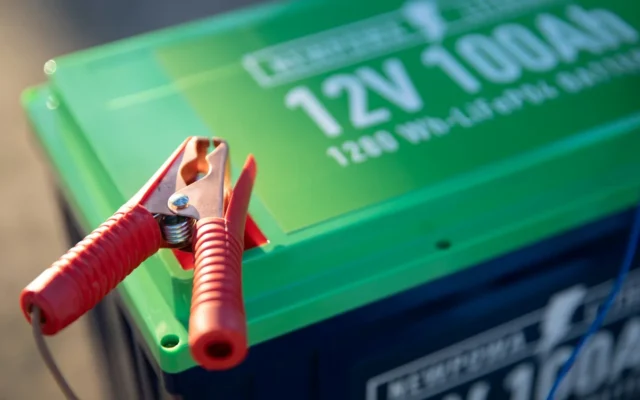
| 12.8V 100Ah | 1.28kWh |
| 25.6V 100Ah | 2.56kWh |
| 25.6V 200Ah | 5.12kWh |
| 51.2V 100Ah | 5.12kWh |
| 51.2V 200Ah | 10.24kWh |
Notice that a 25.6V 200Ah battery and a 51.2V 100Ah battery both store 5.12kWh of nominal energy.
They have the same nominal energy capacity, but their voltage and current characteristics differ. Your inverter must support the chosen battery configuration.
Step 1: Calculate your household electricity consumption
Start by listing the appliances you want to operate using battery power.
For each appliance, identify its average electrical consumption in watts and estimate how many hours it will operate.
Here is an example for a Philippine household:
| Appliance | Average watts | Hours | Energy |
|---|---|---|---|
| 1HP inverter air conditioner | 800W | 6 | 4,800Wh |
| Refrigerator | 100W | 10 | 1,000Wh |
| Electric fan | 60W | 8 | 480Wh |
| LED lights | 50W | 6 | 300Wh |
| Wi-Fi router | 15W | 10 | 150Wh |
| Total | 6,730Wh |
The household requires approximately 6.73kWh of electricity for these loads during the specified operating periods.
These values are illustrative. Refrigerator and inverter air conditioner consumption fluctuate throughout the day, so using measured average consumption produces more accurate estimates.
Formula: Appliance energy consumption

For example, an 800W air conditioner operating for six hours consumes:
800 × 6 = 4,800Wh, or 4.8kWh.
Step 2: Determine how many hours of backup power you need
Next, decide how long you want your appliances to operate without grid electricity or solar charging.
For many Philippine households, common requirements include:
- Short brownout backup of two to four hours.
- Evening electricity use for approximately six hours.
- Overnight backup for eight to twelve hours.
- Longer off-grid operation during extended power interruptions.
Your battery should be sized around the energy needed during the intended backup period, not simply your total daily electricity consumption.
For example, a home using 15kWh per day does not necessarily need a 15kWh battery if only essential appliances require backup.
Step 3: Account for battery depth of discharge
Depth of discharge (DoD) describes how much of the battery’s nominal capacity you plan to use.
LiFePO4 batteries often support relatively deep discharge, but the manufacturer’s recommended operating limits should determine your settings.
For planning purposes, we can use a 90% usable depth of discharge.
This means a 5.12kWh nominal battery provides approximately:
5.12 × 0.90 = 4.61kWh of usable DC energy.
Keeping some reserve can help avoid unexpected shutdowns and may support long-term battery management.
Step 4: Account for inverter efficiency
Solar inverters consume some energy while converting DC electricity from the battery into AC electricity for household appliances.
For preliminary estimates, we can assume 90% conversion efficiency.
Actual efficiency varies by inverter model, operating load, and battery voltage. Standby consumption can also matter during long backup periods with small loads.
To estimate the required nominal battery energy, divide the AC energy demand by the usable depth of discharge and inverter efficiency.
Formula: Required solar battery capacity
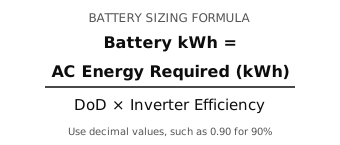
Using our example:
- AC energy requirement: 6.73kWh
- Usable depth of discharge: 90%
- Inverter efficiency: 90%
Required nominal battery capacity:
6.73 ÷ (0.90 × 0.90) = approximately 8.31kWh.
Therefore, the household needs at least 8.31kWh of nominal battery storage under these assumptions.
A practical configuration could be two compatible 51.2V 100Ah batteries connected in parallel, providing 10.24kWh of nominal storage.
Battery paralleling must be supported by the manufacturer, with appropriate wiring, protection, and battery management.
Step 5: Convert battery energy into amp-hours
Battery capacities are often advertised in amp-hours rather than kilowatt-hours.
To calculate the required amp-hour capacity, divide the battery energy in watt-hours by its nominal voltage.
Formula: Battery amp-hour capacity
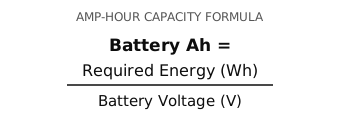
For our 8.31kWh requirement using a 51.2V battery system:
8,310Wh ÷ 51.2V = approximately 162.3Ah.
A 51.2V 200Ah LiFePO4 battery bank would provide more than the required nominal energy capacity.
Step 6: Check battery discharge current
Battery energy capacity alone does not guarantee that your system can operate all appliances.
The battery must also deliver enough current to support the inverter’s output.
Suppose your household has a simultaneous AC load of 3,000W, using a 51.2V battery and an inverter operating at 90% efficiency.
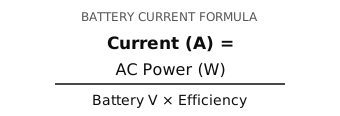
3,000 ÷ (51.2 × 0.90) = approximately 65.1A.
The battery bank must support this current continuously, with additional consideration for temporary load increases and lower battery voltage during discharge.
Also verify inverter surge requirements, BMS discharge ratings, cable sizing, and protective devices.
Recommended battery sizes for common household loads
The following examples assume 90% usable DoD, 90% conversion efficiency, and no solar charging during operation.
| AC energy needed | Minimum nominal battery energy | Example 51.2V configuration |
|---|---|---|
| 1kWh | 1.23kWh | 50Ah provides ample margin |
| 2kWh | 2.47kWh | 50Ah |
| 4kWh | 4.94kWh | 100Ah |
| 6kWh | 7.41kWh | 150Ah or larger |
| 8kWh | 9.88kWh | 200Ah |
| 10kWh | 12.35kWh | 250Ah or larger |
These are energy-based estimates. Battery availability, manufacturer specifications, inverter compatibility, and discharge limits must also be considered.
Calculate your solar battery capacity
Use this solar battery calculator to estimate the nominal battery capacity needed for your household.
For WordPress, this calculator should become a feature of our dedicated battery sizing tool rather than introducing a second, independent calculator implementation.
How much solar battery capacity do you need for overnight use?
For overnight use, calculate the energy consumed by appliances between sunset and sunrise.
For example, a household may operate:
| Appliance | Average consumption | Hours | Energy |
|---|---|---|---|
| 1HP inverter air conditioner | 700W | 8 | 5.60kWh |
| Refrigerator | 80W | 8 | 0.64kWh |
| Electric fan | 50W | 8 | 0.40kWh |
| Wi-Fi router | 15W | 8 | 0.12kWh |
| Total | 6.76kWh |
With 90% DoD and 90% inverter efficiency, the required nominal battery capacity is approximately 8.35kWh.
A 51.2V 200Ah LiFePO4 battery bank, providing 10.24kWh of nominal energy, offers additional capacity under these assumptions.
However, air conditioner consumption varies significantly with room temperature, thermostat settings, insulation, and compressor operation.
Common solar battery sizing mistakes
Even when the basic calculations are correct, several mistakes can lead to an undersized or incompatible installation.
- Comparing batteries using Ah alone. A 12.8V 100Ah battery does not store the same energy as a 51.2V 100Ah battery.
- Ignoring inverter losses. Not all stored DC energy reaches household appliances.
- Overlooking battery discharge limits. A battery may store enough energy but lack the current capability for high-power loads.
- Assuming solar panels always produce rated output. Weather, shading, temperature, and orientation affect actual production.
- Ignoring inverter standby consumption. Long backup periods with small loads can make idle power consumption significant.
- Buying batteries before checking inverter compatibility. Battery voltage, charging profiles, BMS communication, and connection restrictions must match.
Frequently asked questions
How many batteries do I need for a 5kW solar inverter?
A 5kW inverter does not require a fixed number of batteries. The correct battery bank depends on its supported voltage, required backup duration, simultaneous loads, and battery discharge capability.
Is a 100Ah LiFePO4 battery enough for a house?
It depends on voltage and energy demand. A 51.2V 100Ah battery stores 5.12kWh nominally, which may be sufficient for several hours of essential household loads.
Can I use solar panels during the day and batteries at night?
Yes. A properly configured solar system can use daytime solar generation to supply appliances and charge batteries, then use stored energy when solar production is unavailable.
How much battery capacity do I need to run a 1HP air conditioner for eight hours?
If the air conditioner averages 800W, eight hours requires 6.4kWh of AC energy. Assuming 90% DoD and 90% conversion efficiency, you would need approximately 7.90kWh of nominal battery capacity before additional sizing margin and other household loads.
Is it better to install one large battery or multiple smaller batteries?
Either can work. One appropriately rated battery may simplify installation, while multiple compatible batteries can provide modular expansion. Parallel connections must follow manufacturer requirements for balancing, wiring, protection, and BMS operation.
Final verdict
The correct solar battery capacity depends on how much electricity your appliances consume and how long you want to operate them without grid or solar input.
For Philippine homeowners, the most practical approach is to calculate the energy needed during the backup period, account for depth of discharge and inverter efficiency, and choose a compatible battery bank with adequate energy and discharge capability.
Avoid choosing batteries based only on amp-hours or inverter wattage.
A properly sized battery system should balance reliability, usable storage, installation cost, and future expansion.
Continue with our battery runtime calculator, 24V and 48V battery compatibility guide. Use the examples to compare assumptions before requesting a site-specific design.
For general context on storing solar electricity for later use, see the storage section in the U.S. Department of Energy’s Homeowner’s Guide to Solar. For compatibility and operating limits, check the specifications for your exact battery and inverter.