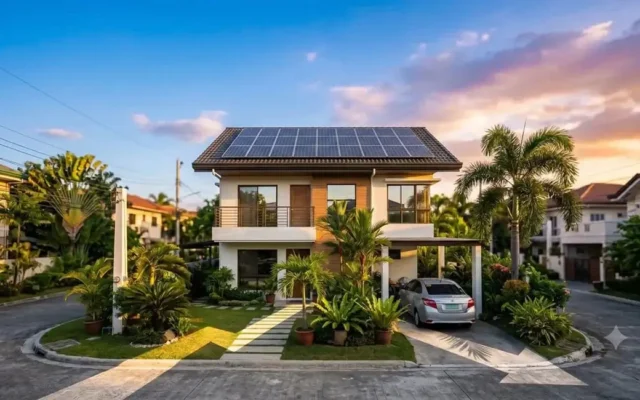

This 3kW vs 5kW solar inverter comparison helps you match appliance demand, battery capacity, budget, and possible future expansion.
For many small Philippine households, a 3kW inverter may be sufficient for essential appliances, lighting, refrigeration, and an efficient air conditioner. A 5kW inverter provides more output capacity for households operating several appliances simultaneously.
However, buying a larger inverter does not automatically mean lower electricity bills or longer battery runtime.
The right choice depends on your simultaneous electrical load, appliance startup requirements, solar panel capacity, battery configuration, and future plans.
In this guide
3kW vs 5kW solar inverter: Main differences
The main difference is their rated AC power output.
A 5kW inverter has approximately 67% more rated output capacity than a 3kW inverter.
That additional capacity can support more appliances operating together, but only when the solar panels, battery, grid supply, and inverter configuration can provide the necessary power.
3kW vs 5kW solar inverter comparison
| Feature | 3kW inverter | 5kW inverter |
|---|---|---|
| Nominal AC output | 3,000W | 5,000W |
| Best suited for | Small homes, essential loads | Medium homes, higher simultaneous loads |
| Air conditioner support | Often one efficient 1HP unit plus smaller loads | Potentially multiple efficient units |
| High-power appliances | More limited combinations | Greater flexibility |
| Battery requirements | Model-dependent | Model-dependent |
| Solar panel compatibility | Check MPPT limits | Check MPPT limits |
| Initial inverter cost | Generally lower | Generally higher |
| Expansion flexibility | More limited | Greater AC output headroom |
These are general comparisons. Individual inverter specifications vary significantly, even when two models share the same advertised wattage.
What appliances can a 3kW solar inverter run?
A 3kW inverter is suitable for many households that primarily need electricity for everyday appliances.
Consider this example:
| Appliance | Example running watts |
|---|---|
| 1HP inverter air conditioner | 800W |
| Refrigerator | 150W |
| Television | 100W |
| Electric fan | 60W |
| Five LED lights | 50W |
| Wi-Fi router | 15W |
| Laptop | 65W |
| Total | 1,240W |
This represents approximately 41% of a 3kW inverter’s nominal output rating.
The remaining output capacity provides room for additional loads and fluctuations, although compressor and motor startup demands must still be considered.
A 3kW inverter may struggle when several high-power appliances operate simultaneously, such as an electric kettle, induction cooker, iron, or water heater.
What appliances can a 5kW solar inverter run?
A 5kW inverter provides greater flexibility for households with multiple air conditioners or additional high-power appliances.
Consider a hypothetical household:
| Appliance | Example running watts |
|---|---|
| Two 1HP inverter air conditioners | 1,600W |
| Refrigerator | 150W |
| Television | 100W |
| Washing machine | 500W |
| Electric fans | 120W |
| LED lighting | 100W |
| Wi-Fi router | 15W |
| Total | 2,585W |
This is approximately 52% of a 5kW inverter’s nominal continuous output rating.
However, washing machines, refrigerators, and air conditioners can experience changing power demand. Their combined peak demand may be considerably higher than the example.
A 5kW inverter is not a guarantee that every household appliance can run at the same time.
How many solar panels do you need?
The inverter’s AC output rating does not necessarily equal its supported solar panel capacity.
For example, some 3kW hybrid inverters support PV arrays larger than 3kWp, while certain 5kW models allow solar input above 5kWp.
The actual limit depends on the inverter’s MPPT specifications.
| System | Illustrative solar array |
|---|---|
| 3kW inverter | 2.5 to 4kWp |
| 5kW inverter | 4 to 6kWp |
These ranges are examples, not universal design limits.
Before selecting panels, verify the inverter’s maximum PV input power, operating MPPT voltage range, maximum PV open-circuit voltage, input current, and string configuration.
Oversizing a PV array beyond an inverter’s permitted specifications can damage equipment or violate installation requirements.
Does a 5kW inverter need a bigger battery?
Not necessarily.
Battery sizing should be based on the energy you want to store and the electrical loads you expect to operate.
For example:
| Battery | Nominal stored energy |
|---|---|
| 25.6V 100Ah | 2.56kWh |
| 25.6V 200Ah | 5.12kWh |
| 51.2V 100Ah | 5.12kWh |
| 51.2V 200Ah | 10.24kWh |
A 5kW inverter can potentially draw more power than a 3kW inverter, so battery discharge capability becomes especially important.
At 5,000W AC output and 90% inverter efficiency, a 51.2V battery system would need to supply approximately 109A before accounting for voltage variation and other losses.
A battery management system rated below the required discharge current may limit output or shut down under heavy loads.
Always check battery voltage compatibility, continuous discharge current, BMS limits, and inverter charging requirements.
How long can a 3kW or 5kW inverter run on a battery?
Runtime is determined primarily by actual load, not the inverter’s maximum rating.
Suppose you use a 51.2V 100Ah LiFePO4 battery with 90% usable depth of discharge and 90% conversion efficiency.
Estimated usable AC energy: 51.2 x 100 x 0.9 x 0.9 = 4,147.2 Wh
| Actual AC load | Estimated runtime |
|---|---|
| 500W | 8.3 hours |
| 1,000W | 4.1 hours |
| 1,500W | 2.8 hours |
| 2,000W | 2.1 hours |
| 3,000W | 1.4 hours |
| 5,000W | 0.8 hours |
These estimates exclude other losses and assume the battery can deliver the required discharge current.
A 5kW inverter operating a 1,000W load does not inherently consume five times as much energy as a 3kW inverter operating the same load. Actual differences depend on conversion efficiency and standby consumption.
Is a 5kW solar inverter more efficient than a 3kW inverter?
Not automatically.
Inverter efficiency depends on the model, design, and operating load.
An oversized inverter operating at a very low load may have greater standby consumption than a smaller model designed for that operating range.
For households with relatively modest electricity demand, buying a 5kW inverter solely because it has a higher rating may not provide meaningful savings.
Compare manufacturer efficiency curves and idle consumption rather than assuming that higher wattage means better performance.
3kW vs 5kW solar inverter: Which suits your home?
Small household or essential-load backup
A 3kW inverter is often sufficient when the simultaneous load remains modest and large heating appliances are not operated together.
Household with multiple air conditioners
A 5kW inverter offers additional headroom, provided the combined compressor demand and other appliances stay within the equipment’s limits.
Future solar expansion
A 5kW inverter may reduce the need for early replacement if you expect your simultaneous electrical demand to increase. Verify PV and battery expansion support separately.
Frequently asked questions
Can a 3kW solar inverter run a refrigerator and air conditioner together?
Generally, yes, if their combined running consumption and startup demands remain within the inverter’s continuous and surge ratings.
Can a 5kW inverter run two 1HP air conditioners?
Many 5kW inverters can support two efficient 1HP inverter-type air conditioners, provided their combined maximum demand and other connected loads remain within the inverter’s specifications.
Is a 5kW inverter enough for an entire house?
It may be sufficient for many homes, but not all. Households with electric showers, multiple induction cookers, large water pumps, or several air conditioners may exceed 5kW during peak usage.
Can I connect 5kW of solar panels to a 3kW inverter?
Only if the specific inverter supports that PV array capacity and the proposed string configuration satisfies all voltage and current limits. Never assume compatibility based solely on the inverter’s AC output rating.
Is it better to buy a larger inverter for future expansion?
A larger inverter can make sense when future load growth is reasonably predictable. Otherwise, it may increase upfront cost and idle consumption without providing immediate value.
Final verdict
For Philippine households with modest simultaneous electricity demand, a 3kW solar inverter can be a practical and economical choice.
For households operating multiple air conditioners, larger appliances, or planning additional electrical loads, a 5kW inverter provides more flexibility.
The best decision is to calculate your actual simultaneous load, account for compressor and motor startup demand, and select an inverter with appropriate headroom.
Remember that inverter size determines how much AC power can be delivered, while solar panels and batteries determine how much energy is available and for how long.
Continue with our inverter size calculator, hybrid and off-grid inverter comparison, battery sizing guide. Use the examples to compare assumptions before requesting a site-specific design.
For background on rooftop suitability, system planning, and choosing an installer, see the U.S. Department of Energy’s Homeowner’s Guide to Solar. It covers general planning principles; Philippine tariffs and utility requirements differ.
Before finalizing a 3kW vs 5kW solar inverter choice, ask the installer to document the simultaneous running load and startup demand assumed in the design. Confirm the exact inverter model, battery operating-voltage range, BMS current rating, and planned PV string configuration. Keep that design sheet with the quotation so future additions can be checked against the original assumptions.