Off-grid solar can help remote Philippine farms and island homes manage limited electricity access, frequent power interruptions, and expensive diesel generator operation.
For properties far from the nearest distribution line, connecting to the electricity grid can also require substantial infrastructure investment.
An off-grid solar system offers an alternative by generating electricity from sunlight and storing energy in batteries for use at night or during periods of low solar production.
However, designing an off-grid solar installation requires more planning than installing solar panels on a typical grid-connected home.
The system must supply electricity even when sunlight is limited. That means choosing the right solar panel capacity, battery storage, inverter, and backup power arrangement.
This guide explains how off-grid solar works in the Philippines, how to size a system for farms and island homes, what equipment you need, and how to estimate installation costs.
In this guide
What is an off-grid solar system?
An off-grid solar system is an electricity generation system designed to operate independently of the utility grid.
Unlike a grid-tied installation, it does not rely on the distribution network to supply electricity when solar production is insufficient.
A typical off-grid system includes:
- Solar panels that generate electricity during daylight hours.
- A solar charge controller or inverter with built-in MPPT charging.
- Batteries that store electricity for nighttime use.
- An off-grid inverter that supplies AC electricity to appliances.
- Electrical protection, wiring, and mounting equipment.
- An optional generator for extended periods of poor weather.
During the day, solar panels supply electricity to connected loads and charge the battery bank.
At night, the batteries provide stored energy through the inverter.
When the batteries reach their minimum allowable state of charge, the system must reduce or disconnect loads unless another power source is available.
For an explanation of different inverter configurations, see our guide on hybrid vs off-grid solar inverters.
Off-grid vs grid-tied solar
| Feature | Off-grid solar | Grid-tied solar |
|---|---|---|
| Utility connection | Not required | Required |
| Battery storage | Usually essential | Optional |
| Nighttime electricity | Battery or generator | Grid or battery |
| Operation during grid outages | Independent of grid | Usually shuts down without backup capability |
| Initial investment | Often higher | Often lower |
| Main application | Remote properties | Grid-connected homes |
| Backup generator | Often recommended | Optional |
Off-grid systems are especially relevant for remote farms, mountain properties, island homes, and other locations where electricity infrastructure is limited.
However, being located on an island does not automatically mean an off-grid installation is the best choice. If reliable utility service is available, a grid-connected or hybrid system may be more economical.
Is off-grid solar practical in the Philippines?
The Philippines has substantial solar energy potential, making solar power a practical option for many remote locations.
However, solar resources vary by province, season, weather, and installation conditions.
The Global Solar Atlas provides location-specific solar resource estimates that can help evaluate potential generation.
For preliminary calculations, many solar planning examples use approximately 4 to 5 peak sun hours per day.
This is a simplified assumption, not a guarantee that every Philippine location receives that amount throughout the year.
Why off-grid solar is useful for remote properties
Off-grid solar can be particularly valuable where:
- Connecting to the utility grid would require expensive line extensions.
- Diesel fuel delivery is difficult or costly.
- Electricity is needed for essential farm operations.
- Island properties have limited generator operating hours.
- Reliable refrigeration, lighting, or communications are necessary.
For example, a remote farm may need electricity for water pumping, lighting, security cameras, refrigeration, and internet connectivity.
An island home may require power for fans, refrigerators, lights, water pumps, and basic electronics.
In both cases, the system should be designed around the property’s actual electricity requirements rather than selecting an inverter based solely on advertised wattage.
How much electricity does an off-grid home need?
Before choosing solar panels or batteries, calculate the property’s daily electricity consumption.
Electricity demand is measured in kilowatt-hours (kWh).
A 100W appliance running for 10 hours consumes 1kWh.
A 1,000W appliance running for one hour also consumes 1kWh.
Example: Small off-grid island home
Consider a small household using the following appliances:
| Appliance | Power | Daily usage | Daily energy |
|---|---|---|---|
| 8 LED lights | 80W total | 6 hours | 0.48kWh |
| Refrigerator | 100W average while running | 10 equivalent hours | 1.00kWh |
| 3 electric fans | 180W total | 8 hours | 1.44kWh |
| Television | 100W | 4 hours | 0.40kWh |
| Wi-Fi router | 15W | 24 hours | 0.36kWh |
| Phone and laptop charging | 100W | 3 hours | 0.30kWh |
| Total | 3.98kWh |
This household consumes approximately 4kWh per day.
Actual refrigerator consumption depends on its efficiency, ambient temperature, door openings, and compressor duty cycle. A plug-in energy meter or appliance energy label can provide a better estimate.
The table also excludes inverter standby consumption and other system losses.
Daily electricity consumption formula
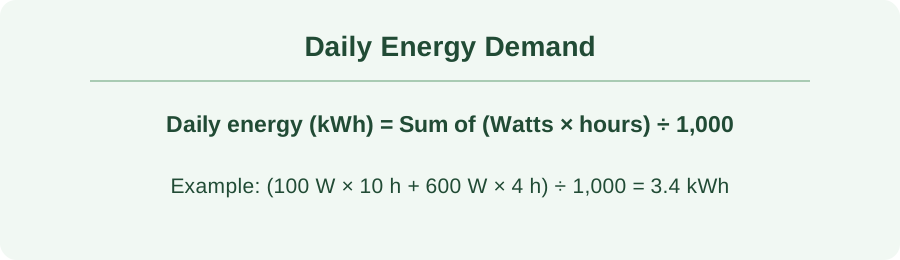
Daily Energy (kWh) = Appliance Power (W) × Operating Hours ÷ 1,000
For multiple appliances, calculate each appliance’s daily consumption and add the results.
A load inventory should include appliances used only occasionally, such as water pumps, washing machines, or power tools.
For farms, these occasional loads can have a major effect on inverter sizing even if they contribute relatively little to total daily energy consumption.
How many solar panels do you need for an off-grid system?
Solar panel capacity depends on daily electricity demand and the amount of sunlight available during the system’s design period.
For preliminary sizing, use:
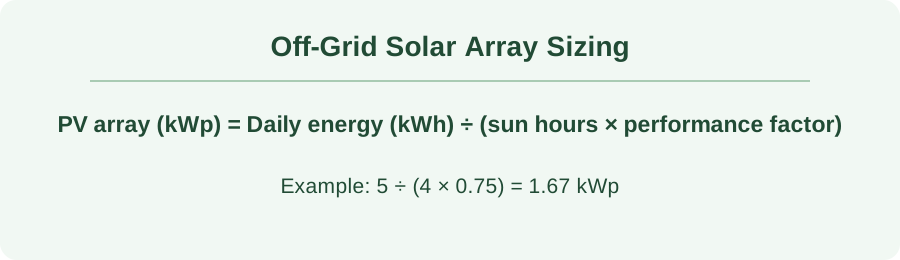
Required Solar Capacity (kWp) = Daily Energy Demand (kWh) ÷ (Peak Sun Hours × Performance Factor)
Suppose a small island home consumes 4kWh daily.
Assume:
- Daily electricity demand: 4kWh
- Peak sun hours: 4 hours
- Performance factor: 75%
Required solar capacity:
4 ÷ (4 × 0.75) = 1.33kWp
This is a preliminary energy-balance estimate.
It does not yet include additional capacity for charging batteries after several cloudy days, seasonal variability, equipment degradation, or future electricity demand.
For a remote property, designing exactly to this minimum would leave little margin.
A larger array may be justified after examining local solar conditions and the required reliability level.
Example solar panel configurations
| Solar array | Example panels | Estimated daily production |
|---|---|---|
| 1.65kWp | 3 × 550W | 4.95kWh |
| 2.20kWp | 4 × 550W | 6.60kWh |
| 3.30kWp | 6 × 550W | 9.90kWh |
| 5.50kWp | 10 × 550W | 16.50kWh |
These estimates assume four peak sun hours and a 75% performance factor.
They are illustrative daily energy estimates, not guaranteed rainy-season production.
For a more detailed calculation, use the NREL PVWatts Calculator and review the property’s seasonal generation profile.
Our related article on how many solar panels a Philippine home needs provides additional panel sizing examples.
Why off-grid systems often need extra solar capacity
A grid-connected home can purchase electricity when solar production is insufficient.
An off-grid property cannot.
This makes low-sunlight periods more important when selecting solar array capacity.
Additional solar panels can help recharge batteries after cloudy weather, but they cannot guarantee uninterrupted electricity during prolonged storms.
A reliable design must consider solar generation, battery storage, load management, and backup power together.
How much battery storage does an off-grid solar system need?
Battery storage is one of the most important components of an off-grid installation.
Solar panels generate electricity during daylight hours, but many household appliances operate at night.
Batteries supply electricity when solar generation is unavailable or insufficient.
The required battery capacity depends on:
- Daily electricity consumption.
- Desired backup duration.
- Allowable depth of discharge.
- Inverter efficiency.
- Battery operating limits.
- Expected periods of low solar production.
Battery autonomy explained
Battery autonomy describes how long the battery bank can supply the required loads without receiving additional solar energy.
For example, a system with two days of autonomy should have enough usable stored energy to support the planned loads for approximately two days.
This is particularly important for island homes where generator fuel or replacement equipment may be difficult to obtain.
Off-grid battery sizing formula
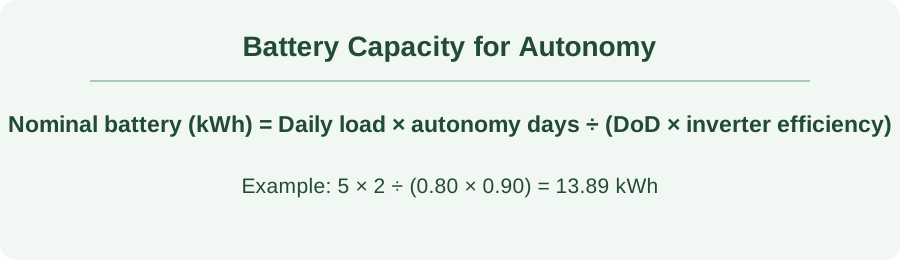
Nominal Battery Capacity (kWh) = Daily Energy Demand × Autonomy Days ÷ (Usable Depth of Discharge × Inverter Efficiency)
Suppose an off-grid home requires 5kWh daily and the owner wants two days of battery autonomy.
Assume:
- Daily consumption: 5kWh
- Autonomy: 2 days
- Usable depth of discharge: 80%
- Inverter efficiency: 90%
Required nominal battery capacity:
5 × 2 ÷ (0.80 × 0.90) = 13.89kWh
This is a simplified energy calculation. Actual design should also account for inverter standby losses, battery aging, temperature, discharge limits, and charging efficiency.
Example LiFePO4 battery configurations
| Battery configuration | Nominal capacity |
|---|---|
| 12.8V 200Ah | 2.56kWh |
| 25.6V 200Ah | 5.12kWh |
| 51.2V 100Ah | 5.12kWh |
| 51.2V 200Ah | 10.24kWh |
| 51.2V 300Ah | 15.36kWh |
A 51.2V 300Ah battery provides approximately 15.36kWh of nominal energy.
Under the previous assumptions, it could supply approximately:
15.36 × 0.80 × 0.90 = 11.06kWh of usable AC energy.
That is slightly more than two days of electricity for a home consuming 5kWh daily, before additional losses and reserve allowances.
Our 100Ah LiFePO4 battery runtime guide explains how voltage, battery capacity, and appliance load affect runtime.
Why LiFePO4 batteries are worth considering
LiFePO4 batteries are commonly used for residential solar storage because they offer useful cycle-life characteristics and are available in modular configurations.
However, not all LiFePO4 batteries are interchangeable.
Before purchasing, verify the battery management system, maximum charge and discharge currents, operating temperature limits, communication compatibility, and warranty.
For remote installations, after-sales support and replacement availability are especially important.
What inverter size is best for an off-grid farm or island home?
The inverter determines how much AC power the system can supply at one time.
A property consuming 5kWh daily does not necessarily require a 5kW inverter.
Daily energy consumption and instantaneous power demand are different measurements.
For example, a home might consume only 4kWh per day but briefly require 2.5kW when a water pump and other appliances operate together.
The inverter must support the simultaneous running loads and any motor startup requirements.
Typical off-grid inverter applications
| Inverter size | Possible application |
|---|---|
| 1kW | Basic lighting, electronics, and small loads |
| 2kW | Small cabin or modest household |
| 3kW | Small home with selected appliances |
| 5kW | Larger household or mixed residential loads |
| 8kW and above | Higher-demand homes or farm applications |
These are general application examples, not fixed sizing rules.
Actual selection depends on appliance specifications and inverter performance.
Water pumps require special attention
Water pumps are common on farms and island properties.
However, their electrical requirements depend on motor type, pump design, operating pressure, and startup characteristics.
A pump rated at 750W may require substantially more power during startup.
The inverter must be capable of handling the motor’s starting demand.
A soft starter, variable-frequency drive, or appropriately designed solar pumping system may reduce startup requirements in some applications.
For farms where pumping can be scheduled during daylight hours, direct solar pumping into an elevated water tank may be more economical than storing all pumping energy in batteries.
The tank effectively stores water for later use, reducing the need for electrical storage.
Off-grid solar for Philippine farms
Farms often have different electricity requirements from residential homes.
Instead of primarily powering household appliances, a farm may need electricity for irrigation, water supply, refrigeration, lighting, security, and communications.
Common farm applications
Irrigation and water pumping
Solar-powered pumps can supply water to crops, livestock, or storage tanks.
For systems that operate only during daylight hours, battery storage may not be necessary.
Cold storage and refrigeration
Refrigeration can help preserve agricultural products, dairy, seafood, and other temperature-sensitive goods.
Because refrigeration may need to operate continuously, battery storage and backup power are important.
Farm lighting and security
LED lighting, CCTV cameras, and communication equipment generally have modest power requirements but may operate throughout the night.
Remote monitoring
Solar systems can support internet routers, sensors, weather stations, and other monitoring devices.
Example: Small farm electricity demand
| Equipment | Daily energy |
|---|---|
| Water pump | 3.0kWh |
| Farm lighting | 0.8kWh |
| Refrigeration | 2.0kWh |
| CCTV and communications | 0.5kWh |
| Miscellaneous equipment | 0.7kWh |
| Total | 7.0kWh |
A farm consuming 7kWh daily needs a different configuration from an island home consuming 4kWh.
The design must also consider whether pumping occurs during the day and whether refrigeration requires uninterrupted electricity.
Separate essential and flexible loads
A practical farm installation can divide electricity demand into two categories.
Essential loads: Refrigeration, security systems, communications, and other equipment that must continue operating.
Flexible loads: Irrigation pumps, some processing equipment, and other tasks that can be scheduled when solar production is strong.
This approach can reduce battery requirements and improve overall system efficiency.
Off-grid solar for island homes
Island homes face additional challenges beyond electricity generation.
These may include transportation costs, limited technical support, salt exposure, strong winds, and delays in obtaining replacement components.
Coastal corrosion
Salt-laden air can accelerate corrosion of exposed metal components and electrical connections.
For coastal installations, select mounting systems, enclosures, connectors, and protective equipment appropriate for the environment.
The equipment manufacturer’s environmental ratings and installation requirements should guide material selection.
Typhoon exposure
Solar mounting systems must be designed for local wind conditions.
Roof attachments should be evaluated by qualified professionals, especially on older structures or roofs exposed to strong coastal winds.
Equipment accessibility
A remote property should prioritize equipment that can be inspected, maintained, and replaced without unnecessary complexity.
Monitoring equipment can help identify charging problems, abnormal battery behavior, and declining solar production before a complete outage occurs.
Backup power
For island homes where electricity is essential, a generator may still be advisable.
Solar panels and batteries can reduce generator operating hours, while the generator provides an additional energy source during extended periods of poor weather.
How much does an off-grid solar system cost in the Philippines?
Off-grid solar installation costs vary considerably because battery storage requirements differ from property to property.
Two systems using the same 5kW inverter may have very different prices if one includes 5kWh of batteries and the other includes 20kWh.
For preliminary budgeting, consider the following illustrative ranges.
| Off-grid configuration | Example application | Planning budget |
|---|---|---|
| Small 1kW to 2kW system | Cabin, basic lighting, electronics | ₱80,000 to ₱180,000 |
| 3kW system with modest storage | Small island home | ₱180,000 to ₱350,000 |
| 5kW system with approximately 10kWh storage | Medium home or small farm | ₱300,000 to ₱550,000 |
| Larger 5kW to 8kW system with extended storage | Higher-demand remote property | ₱450,000 to ₱850,000+ |
These are illustrative budgeting allowances, not verified current Philippine supplier quotations.
The final price depends on the actual panel array, battery capacity, inverter, installation complexity, transportation, and site requirements.
Remote properties may also incur substantial freight, boat transport, accommodation, and equipment handling expenses.
For general residential solar pricing, see our article on solar installation costs in the Philippines.
Why off-grid solar costs more than grid-tied solar
A grid-connected system can rely on utility electricity when solar production is insufficient.
An off-grid system must provide its own energy reserve.
This often requires larger battery capacity, additional electrical equipment, and backup power provisions.
For many remote properties, batteries represent a significant portion of the installation budget.
However, comparing only the upfront cost can be misleading.
A property that relies on diesel generation should also consider fuel expenses, maintenance, generator replacement, and the cost of transporting fuel.
Off-grid solar vs diesel generators
Diesel generators remain useful for remote electricity supply because they can provide power when fuel is available.
However, regular generator operation involves fuel consumption, maintenance, noise, and emissions.
Solar systems have higher upfront equipment costs but can reduce recurring fuel consumption.
Comparison
| Factor | Off-grid solar | Diesel generator |
|---|---|---|
| Initial investment | Higher for systems with batteries | Often lower |
| Fuel requirements | Sunlight, with stored energy | Diesel fuel |
| Operating noise | Low | Higher |
| Routine maintenance | Equipment inspection and servicing | Engine servicing and fuel-system maintenance |
| Electricity during prolonged cloudy weather | Limited by storage and backup | Available while fuel and equipment remain operational |
| Best application | Regular daily electricity demand | Backup or intermittent high-power demand |
For remote farms, a hybrid approach using solar, batteries, and a generator may provide a practical balance.
Solar supplies regular electricity demand, batteries support nighttime operation, and the generator provides additional power when necessary.
Should you eliminate the generator entirely?
Not always.
For essential refrigeration, medical equipment, communications, or other critical loads, relying on solar and batteries alone may create unnecessary risk.
A generator can provide resilience during prolonged cloudy periods, equipment faults, or unusually high electricity consumption.
The appropriate backup strategy depends on how costly or dangerous a power interruption would be.
How do you design an off-grid system for the rainy season?
Rainy-season performance is one of the most important considerations for Philippine off-grid solar installations.
A system sized using average annual sunlight may not produce enough electricity during consecutive cloudy days.
Use conservative solar assumptions
Instead of designing only around average daily sunlight, evaluate lower-production months.
The Global Solar Atlas and PVWatts can support preliminary solar resource assessments.
For critical installations, more detailed modeling using local weather data is advisable.
Increase battery autonomy when justified
Additional battery storage can extend the period that essential loads remain powered without solar charging.
However, larger batteries increase upfront cost.
The goal is to balance storage capacity, backup generation, and acceptable outage risk.
Prioritize essential loads
During extended cloudy periods, nonessential appliances can be temporarily disconnected.
For example, refrigeration and communications may take priority over entertainment equipment or optional lighting.
Consider generator integration
A generator-compatible inverter can allow batteries to recharge when solar generation remains insufficient.
Generator charging capacity, transfer arrangements, fuel availability, and safe electrical integration must be included in the design.
Plan for battery recovery
A battery bank may support two days of autonomy, but the solar array must also be capable of recharging it while continuing to supply household loads.
This is why battery autonomy and solar array capacity should be evaluated together.
Common off-grid solar installation mistakes
Buying an inverter before calculating loads
A large inverter does not guarantee enough daily electricity.
The system still needs adequate solar generation and battery storage.
Installing too few solar panels
An undersized array may struggle to recharge batteries during periods of limited sunlight.
This can lead to frequent low-battery shutdowns.
Oversizing the inverter unnecessarily
A larger inverter can cost more and may have higher standby consumption.
Select an inverter that supports actual loads, startup requirements, and reasonable future expansion.
Ignoring battery discharge limits
A battery may have sufficient nominal energy but insufficient discharge current to support a large inverter load.
Check both energy capacity and power delivery limits.
Using unsuitable coastal hardware
Corrosion and poor mounting practices can shorten equipment life and create safety problems.
Skipping electrical protection
Off-grid systems require appropriate overcurrent protection, isolation, grounding, surge protection, and correctly sized conductors.
Installation should follow applicable Philippine electrical requirements and manufacturer instructions.
Assuming batteries eliminate every power interruption
Even a large battery bank can become depleted.
Critical loads require a realistic backup and recovery strategy.
Can you expand an off-grid solar system later?
Yes, but expansion should be considered during the initial design.
Potential upgrades include:
- Additional solar panels.
- Larger battery storage.
- Additional inverter capacity.
- New appliance circuits.
- Generator integration.
- Remote monitoring.
However, expansion is not always as simple as connecting another battery or solar panel.
Solar arrays must remain within the inverter’s voltage and current limits.
Battery expansion must follow the manufacturer’s compatibility and parallel-operation requirements.
Mixing different battery models, capacities, or ages without manufacturer approval can create operational and safety problems.
If future expansion is likely, choose equipment with clearly documented expansion capabilities.
Is off-grid solar worth it for a Philippine farm or island home?
Off-grid solar can be worthwhile when electricity is needed regularly and connecting to the utility grid is impractical or expensive.
For island homes, it can provide electricity for lighting, refrigeration, fans, communications, and selected household appliances.
For farms, it can support irrigation, water supply, security, and agricultural operations.
However, the investment should be evaluated against available alternatives.
If utility electricity is nearby and affordable, grid connection may be more economical.
If electricity is needed only occasionally, a smaller solar installation or generator may be sufficient.
If the property requires reliable electricity every day, a properly designed solar-battery system with backup generation may offer greater long-term value.
The best configuration depends on actual electricity demand, seasonal solar resources, reliability requirements, and total ownership costs.
Frequently asked questions
How much does an off-grid solar system cost in the Philippines?
Costs vary by solar panel capacity, inverter size, battery storage, and installation requirements. Small systems may require a relatively modest budget, while larger residential and farm installations with substantial battery storage can cost several hundred thousand pesos.
Can a 3kW solar system power an off-grid house?
Yes, if the household’s simultaneous power demand and daily electricity consumption are compatible with the system’s inverter, solar array, and battery capacity.
How many batteries do I need for an off-grid solar system?
Battery requirements depend on daily electricity consumption, desired autonomy, allowable depth of discharge, and inverter efficiency. For example, a home consuming 5kWh daily with two days of autonomy may require approximately 13.9kWh of nominal battery capacity under the assumptions used in this guide.
Is a 5kW off-grid solar system enough for a farm?
Possibly. It depends on the farm’s pumps, refrigeration equipment, motors, and other electrical loads. Some farms may require larger inverters, dedicated solar pumping systems, or additional backup generation.
Can off-grid solar run an air conditioner?
Yes, provided the inverter supports the air conditioner’s running and startup requirements and the solar and battery system can supply the required energy.
Do off-grid solar systems work during rainy weather?
Yes, but solar generation generally decreases under cloudy conditions. Batteries and backup generators can help maintain electricity supply when solar production is insufficient.
Is net metering available for off-grid solar systems?
A fully off-grid system does not export electricity to a utility network, so conventional grid-connected net metering does not apply. Net metering is relevant to eligible grid-connected renewable energy systems.
What is the best battery for off-grid solar in the Philippines?
LiFePO4 batteries are a strong option for many residential applications, but selection should consider usable capacity, discharge limits, operating temperature, warranty, compatibility, and local support.
How long can an off-grid solar system last?
Solar panels commonly carry long-term performance warranties, while inverters and batteries may need replacement earlier. Actual service life depends on equipment quality, environmental conditions, maintenance, and usage.
Should an island home have a backup generator?
For properties requiring dependable electricity during extended cloudy periods, a properly integrated backup generator is often worth considering.
Final verdict: Choosing the right off-grid solar system
Off-grid solar can provide a practical electricity solution for Philippine farms, island homes, and remote properties where utility power is unavailable or unreliable.
However, successful installations require more than choosing a popular inverter size.
Start by calculating daily electricity consumption and identifying essential appliances.
Next, size the solar array using conservative sunlight assumptions and determine the battery capacity required for nighttime operation and low-production periods.
For farms, consider whether irrigation and pumping loads can operate directly from solar energy during daylight hours.
For island homes, prioritize reliable battery storage, corrosion-resistant equipment, safe mounting, and access to maintenance support.
Finally, evaluate whether backup generation is necessary.
The best off-grid solar system is the one that can reliably supply the electricity your property needs, including during periods when sunlight is limited.
Use our solar panel calculator, battery size calculator, and inverter size calculator to explore your assumptions. Compare the estimates with equipment specifications and a site assessment before selecting a system.