
Sizing an off-grid solar system in the Philippines requires more than choosing a 3kW or 5kW inverter and connecting a few solar panels.
A properly sized system must generate enough electricity during the day, store sufficient energy for nighttime use, and support the combined power requirements of household appliances.
For remote homes, farms, and island properties, reliability becomes even more important because utility electricity may not be available when solar production is insufficient.
To size an off-grid solar system, you need to calculate four things: daily electricity consumption, maximum simultaneous power demand, required solar panel capacity, and battery storage for the desired backup duration.
For example, a home consuming 6kWh daily might require approximately 2.3kWp of solar panels under a simplified low-sunlight design scenario, plus around 16.7kWh of nominal LiFePO4 battery storage for two days of autonomy.
However, these figures are preliminary. Actual equipment selection depends on location, appliance startup requirements, charging losses, seasonal weather, and the system’s reliability requirements.
This guide walks through the calculations using practical examples for Philippine households.
In this guide
What determines the size of an off-grid solar system?
An off-grid solar system has three major sizing requirements.
Solar panel capacity determines how much electricity the system can generate from available sunlight.
Battery capacity determines how much energy can be stored for nighttime use and periods of low solar production.
Inverter capacity determines how much AC power the system can deliver at one time.
These components work together, but they solve different problems.
For example, installing a 5kW inverter does not mean your system can generate 5kWh of electricity every hour.
Similarly, installing a large battery does not guarantee reliable electricity if the solar array cannot recharge it.
Solar system sizing overview
| Component | Main sizing factor | Measurement |
|---|---|---|
| Solar panels | Daily energy demand and solar resource | kWp |
| Battery storage | Energy demand and autonomy | kWh |
| Inverter | Simultaneous loads and startup surge | kW or W |
| Charge controller | PV electrical specifications and charging current | V and A |
| Backup generator | Essential loads and charging requirements | kW or kVA |
The most reliable approach is to calculate household electricity demand before choosing equipment.
For a broader explanation of system types and applications, read our guide, Off-Grid Solar in the Philippines for Farms and Island Homes.
Step 1: Calculate your daily electricity consumption
Start by listing every appliance you intend to power.
For each appliance, identify its operating wattage and estimated daily usage.
Electricity consumption is measured in kilowatt-hours (kWh).
Daily energy consumption formula
Daily Energy (kWh) = Appliance Power (W) × Operating Hours ÷ 1,000
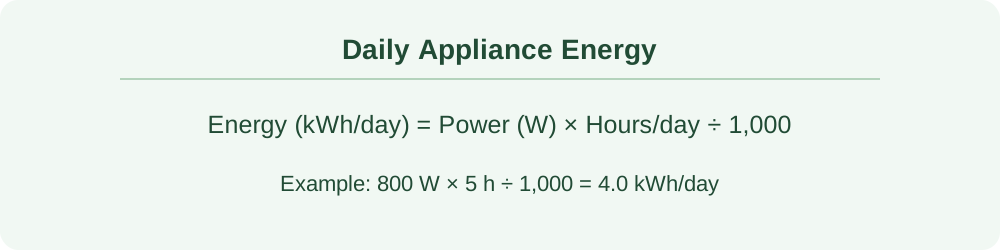
For multiple appliances, calculate the energy consumption of each one and add the results.
Example: Philippine off-grid household
Consider a small household with the following appliances.
| Appliance | Running power | Daily usage | Daily energy |
|---|---|---|---|
| Refrigerator | 120W | 10 equivalent hours | 1.20kWh |
| 4 electric fans | 240W total | 8 hours | 1.92kWh |
| 8 LED lights | 80W total | 6 hours | 0.48kWh |
| Television | 100W | 4 hours | 0.40kWh |
| Wi-Fi router | 15W | 24 hours | 0.36kWh |
| Laptop | 65W | 5 hours | 0.325kWh |
| Water pump | 750W | 1 hour | 0.75kWh |
| Phone charging | 40W | 3 hours | 0.12kWh |
| Total | 5.555kWh |
The household consumes approximately 5.56kWh per day.
For preliminary sizing, we can round this to 6kWh daily to provide a modest allowance.
This does not replace a proper design margin for seasonal weather, future loads, or system losses.
Important: Refrigerator energy consumption
A refrigerator does not normally operate at its rated compressor power continuously.
Its actual energy consumption depends on compressor cycling, ambient temperature, insulation, and usage.
For accurate calculations, use the appliance’s energy label or measure consumption over several days with an electricity meter.
The same principle applies to inverter air conditioners, which can operate at different power levels throughout the day.
What if you plan to add appliances later?
If you expect to install additional air conditioners, water pumps, or refrigeration equipment, include those loads in a separate future-demand scenario.
Avoid automatically oversizing the entire system for appliances you may never purchase.
A modular installation with documented expansion capacity may provide better value.
Step 2: Calculate your maximum simultaneous power demand
Daily electricity consumption determines how much energy the system must supply.
However, inverter sizing depends on how much power your appliances require at the same time.
Consider a household operating these appliances simultaneously:
| Appliance | Running power |
|---|---|
| Refrigerator | 120W |
| Two electric fans | 120W |
| Television | 100W |
| LED lighting | 80W |
| Water pump | 750W |
| Total | 1,170W |
The combined running demand is approximately 1.17kW.
However, some appliances require additional power when starting.
Refrigerators, pumps, and other motor-driven equipment can draw considerably more current during startup.
How much inverter capacity do you need?

For a simple preliminary example, suppose the maximum simultaneous running demand is 1,170W.
Adding a 25% planning allowance gives:
1,170 × 1.25 = 1,462.5W
A 2kW inverter might appear sufficient based on running power alone.
However, this does not confirm that the inverter can start the water pump.
You must check the pump’s actual startup characteristics and the inverter’s surge rating and duration.
A planning allowance is not a substitute for verifying motor startup requirements.
Example inverter sizing
| Maximum running demand | Initial inverter capacity to evaluate |
|---|---|
| 800W | 1kW to 1.5kW |
| 1,500W | 2kW to 3kW |
| 2,500W | 3kW to 5kW |
| 4,000W | 5kW or larger |
These are preliminary screening ranges only.
The correct inverter depends on continuous output, surge capability, operating temperature, power factor, and appliance characteristics.
For a technical comparison of inverter types, see Hybrid vs Off-Grid Solar Inverter: Which Is Better in the Philippines?
Step 3: Determine your location’s solar energy potential
Solar panel sizing depends on the amount of usable sunlight available.
In solar calculations, sunlight is often expressed as peak sun hours (PSH).
One peak sun hour represents solar energy equivalent to one hour of irradiance at 1,000W per square meter.
For example, a location receiving 4 peak sun hours has a daily solar energy resource equivalent to four hours at that reference irradiance.
However, actual solar output changes throughout the day.
Solar resources in the Philippines
Solar potential varies across the Philippines.
The Global Solar Atlas Philippines map provides geographical solar resource information and modeled photovoltaic electricity generation potential.
The World Bank’s Philippine solar resource dataset also provides solar irradiation and PV power potential data.
These resources are useful for preliminary assessments, but long-term averages do not represent the worst weather conditions a remote system may experience.
Which peak sun hours should you use?
For illustrative calculations, we can compare three scenarios.
| Scenario | Assumed peak sun hours |
|---|---|
| Favorable solar conditions | 5.0 hours |
| Moderate conditions | 4.0 hours |
| Conservative example | 3.5 hours |
These are calculation assumptions, not measured values for a specific province.
For an actual installation, use location-specific monthly solar resource data.
In particular, an off-grid system should be evaluated against low-production months rather than sized solely from annual averages.
Step 4: Calculate the required solar panel capacity
Once daily electricity consumption and solar resources are known, estimate the solar array capacity.
Solar panel sizing formula
Required PV Capacity (kWp) = Daily Energy Demand (kWh) ÷ (Peak Sun Hours × Performance Factor)

The performance factor accounts for estimated losses between rated solar panel capacity and usable energy production.
These losses may include temperature effects, wiring losses, conversion losses, shading, and other operating factors.
For this example, use a 75% overall performance factor.
Example: Home consuming 6kWh daily
Assume:
- Daily electricity demand: 6kWh
- Peak sun hours: 3.5
- Overall performance factor: 75%
Required solar capacity:
6 ÷ (3.5 × 0.75)
= 6 ÷ 2.625
= 2.29kWp
This means approximately 2.29kWp of solar panels would be needed to generate 6kWh daily under the assumed conditions.
However, this is an energy-balance estimate, not a complete off-grid system design.
If batteries must recover from several days of low charge, additional solar capacity may be necessary.
How many 550W solar panels are needed?
Using 550W solar panels:
2,290W ÷ 550W = 4.16 panels
Since solar panels are installed as whole modules, at least five panels would be needed to exceed the calculated capacity.
Five 550W panels provide:
5 × 550W = 2,750W or 2.75kWp
Solar panel sizing comparison
| Daily electricity demand | Required PV capacity | 550W panels |
|---|---|---|
| 3kWh | 1.14kWp | 3 |
| 4kWh | 1.52kWp | 3 |
| 6kWh | 2.29kWp | 5 |
| 8kWh | 3.05kWp | 6 |
| 10kWh | 3.81kWp | 7 |
| 15kWh | 5.71kWp | 11 |
Calculations assume 3.5 peak sun hours and a 75% performance factor.
The panel counts are rounded up to the next whole panel. Final string configurations must satisfy the inverter’s MPPT voltage, current, and other electrical requirements.
Why actual off-grid systems may need more panels
A solar array designed only to match daily consumption may struggle to recharge depleted batteries.
Suppose your household consumes 6kWh daily.
After several cloudy days, the battery bank may need an additional 8kWh of charging energy.
The solar array must then supply both the household’s current electricity demand and energy for battery recovery.
A larger array can reduce recovery time when sufficient sunlight is available.
For more accurate production estimates, use the PVWatts Calculator.
PVWatts primarily models grid-connected photovoltaic generation, so its output should be treated as a solar production input rather than a complete off-grid reliability assessment.
The System Advisor Model photovoltaic documentation explains more detailed modeling options.
Step 5: Calculate your off-grid battery capacity
Battery storage allows the system to supply electricity at night and during periods of insufficient solar generation.
The correct battery capacity depends on daily consumption, desired autonomy, usable depth of discharge, and conversion losses.
What is battery autonomy?
Battery autonomy is the period during which stored energy can supply the required loads without additional charging.
For example:
- One day of autonomy supports one day of planned consumption.
- Two days of autonomy supports two days.
- Three days of autonomy supports three days.
For remote Philippine properties, the appropriate autonomy depends on acceptable outage risk and backup generator availability.
More autonomy generally requires more battery capacity and increases installation cost.
Battery sizing formula

Example: Two days of autonomy
Assume:
- Daily electricity consumption: 6kWh
- Battery autonomy: 2 days
- Usable depth of discharge: 80%
- Inverter efficiency: 90%
Required nominal battery capacity:
6 × 2 ÷ (0.80 × 0.90)
= 12 ÷ 0.72
= 16.67kWh
This is a simplified nominal battery energy requirement.
It assumes the daily demand is measured as AC energy and does not separately account for inverter standby consumption, battery aging, temperature effects, or additional reserve requirements.
Example LiFePO4 battery configurations
| Battery configuration | Nominal capacity |
|---|---|
| 51.2V 100Ah | 5.12kWh |
| 51.2V 200Ah | 10.24kWh |
| 51.2V 300Ah | 15.36kWh |
| 51.2V 400Ah | 20.48kWh |
Under the example assumptions, a nominal 20.48kWh battery bank would exceed the calculated 16.67kWh requirement.
However, its usable capacity, discharge power, and compatibility must still be verified.
Why battery voltage matters
Battery energy is calculated using voltage and amp-hour capacity.
For example:
51.2V × 200Ah ÷ 1,000 = 10.24kWh
A 12.8V 200Ah battery stores only 2.56kWh.
Both batteries have the same amp-hour rating, but they store very different amounts of energy.
This is why comparing batteries using amp-hours alone can be misleading.
For more examples, read How Long Will a 100Ah LiFePO4 Battery Last?
You can also use our Solar Battery Runtime Calculator to estimate how long a battery can support a particular appliance load.
Step 6: Check battery discharge power and inverter compatibility
Battery capacity determines how much energy can be stored.
However, the battery must also be capable of supplying the inverter’s required power.
Consider a 51.2V 100Ah battery.
Its nominal energy capacity is 5.12kWh.
If its battery management system allows a maximum continuous discharge current of 100A, its approximate nominal DC discharge power is:
51.2V × 100A = 5,120W
However, this does not automatically mean it can continuously supply 5kW of AC power.
The actual usable power depends on battery voltage under load, inverter efficiency, manufacturer limits, operating temperature, and the permitted discharge duration.
Battery compatibility checklist
Before combining an inverter and LiFePO4 battery, verify:
- Nominal battery voltage.
- Maximum charge current.
- Maximum continuous discharge current.
- Battery management system limits.
- Inverter battery communication requirements.
- Supported battery configurations.
- Manufacturer-approved parallel operation.
- Low-voltage protection settings.
For example, a 5kW inverter paired with a small battery may encounter battery discharge limitations even when the battery still contains stored energy.
The inverter and battery should be selected as compatible components rather than independently purchased based only on advertised capacity.
Step 7: Check solar charge controller and MPPT limits
Many modern off-grid and hybrid inverters include built-in MPPT solar charge controllers.
However, their PV input limits vary.
Important specifications include:
Maximum PV open-circuit voltage: The highest permitted solar array voltage under applicable conditions.
MPPT operating voltage range: The voltage range within which the inverter can track maximum power.
Maximum PV input current: The permitted current at each solar input.
Maximum supported PV power: The recommended or permitted solar array capacity.
Example: Five 550W panels
Five panels provide a total rated capacity of 2.75kWp.
However, whether they can be connected in one series string depends on the electrical specifications of the panels and inverter.
For example, five panels with an open-circuit voltage of 50V each would have a nominal combined open-circuit voltage of approximately 250V in series.
Actual open-circuit voltage increases as cell temperature decreases, so temperature-adjusted maximum voltage must be checked.
The same array may also fail to meet an inverter’s minimum MPPT operating voltage under certain configurations.
Never determine panel string configuration using wattage alone.
Final design should use manufacturer datasheets and applicable electrical requirements.
Step 8: Size the system for rainy-season conditions
Off-grid solar systems must continue operating when sunlight is limited.
This is particularly important for remote Philippine properties where utility electricity is unavailable.
A system sized using favorable solar conditions may struggle during extended cloudy periods.
Compare different sunlight assumptions
Consider a 3kWp solar array with a 75% performance factor.
| Peak sun hours | Estimated daily generation |
|---|---|
| 5.0 | 11.25kWh |
| 4.0 | 9.00kWh |
| 3.5 | 7.88kWh |
| 2.0 | 4.50kWh |
| 1.0 | 2.25kWh |
If the household consumes 6kWh daily, the array may produce more than enough energy during favorable conditions.
However, at two peak sun hours, generation falls to approximately 4.5kWh.
That creates a daily energy deficit of around 1.5kWh before considering other losses or battery charging requirements.
During prolonged poor weather, the deficit can accumulate.
Three ways to improve off-grid reliability
Increase solar array capacity. More panels can increase generation during periods when some sunlight is available.
Increase battery storage. Additional usable battery capacity provides more energy reserve.
Add backup generation. A compatible generator can supply electricity and recharge batteries when solar production remains insufficient.
For critical loads, combining these approaches may be more reliable than relying on a very large battery bank alone.
The Philippine Department of Energy’s Renewable Energy Implementation Toolkit provides broader guidance for evaluating renewable energy projects in Philippine communities and facilities.
Step 9: Calculate battery recovery time
Battery autonomy and battery recovery are separate design considerations.
A system may have enough battery storage to survive two cloudy days but insufficient solar capacity to recharge quickly afterward.
Suppose a battery bank needs 8kWh of energy restored.
If the solar array produces 9kWh on a particular day and the household consumes 6kWh, the theoretical energy surplus is:
9 − 6 = 3kWh
At an illustrative 90% battery charging efficiency, approximately:
3 × 0.90 = 2.7kWh
could be stored.
Estimated recovery time:
8 ÷ 2.7 = approximately 3 days
This is a simplified calculation assuming similar production and consumption each day.
Actual charging power may be limited by battery charge-current settings, state of charge, temperature, and available sunlight.
Why this matters
A system that takes several days to recover may remain vulnerable if another cloudy period occurs before the battery is fully charged.
For remote homes, recovery time should be evaluated alongside autonomy.
A larger solar array may be more useful than adding additional battery capacity when the main problem is slow battery recovery.
Step 10: Build a complete off-grid solar configuration
Let’s combine the previous calculations.
Assume a Philippine household requires:
- Daily electricity consumption: 6kWh
- Maximum simultaneous running load: 1.5kW
- Occasional motor loads requiring surge verification
- Conservative planning sunlight: 3.5 peak sun hours
- Performance factor: 75%
- Battery autonomy: 2 days
- Usable depth of discharge: 80%
- Inverter efficiency: 90%
Preliminary system configuration
| Component | Calculated requirement | Initial configuration to evaluate |
|---|---|---|
| Daily energy | 6kWh | 6kWh/day |
| Solar array | 2.29kWp | 2.75kWp or larger |
| Solar panels | At least 2.29kWp | 5 × 550W |
| Battery storage | 16.67kWh nominal | Approximately 20.48kWh nominal |
| Inverter | Above 1.5kW running demand | 3kW class, subject to surge verification |
| Backup generator | Depends on reliability requirements | Optional, but worth evaluating |
This configuration is a starting point for equipment selection, not a final installation design.
The solar array may need to be larger if low-production periods and battery recovery requirements are significant.
The inverter must also be checked against actual motor starting demand and battery discharge capability.
Estimated solar generation
A 2.75kWp array under the assumed conditions would produce:
2.75 × 3.5 × 0.75 = 7.22kWh daily
This provides approximately 1.22kWh above the modeled 6kWh daily demand.
That margin may be insufficient for rapid battery recovery after prolonged cloudy weather.
A larger array, such as 3.3kWp, could improve recovery potential, subject to inverter compatibility and installation constraints.
Should you install a 5kW inverter instead?
Not automatically.
A 5kW inverter may be justified if the household has larger simultaneous loads, significant motor startup requirements, or confirmed expansion plans.
However, a larger inverter can increase equipment cost and standby energy consumption.
Choose inverter capacity based on actual power requirements rather than matching it to the battery’s kWh capacity.
Off-grid solar sizing for farms
Farms often require a different approach because electricity consumption may be concentrated in pumps, motors, refrigeration, and agricultural equipment.
Example farm load schedule
| Equipment | Running power | Daily usage | Daily energy |
|---|---|---|---|
| Irrigation pump | 1,500W | 3 hours | 4.50kWh |
| Refrigeration | 200W average | 12 equivalent hours | 2.40kWh |
| Lighting | 150W | 5 hours | 0.75kWh |
| Security and communications | 50W | 24 hours | 1.20kWh |
| Miscellaneous equipment | 300W | 2 hours | 0.60kWh |
| Total | 9.45kWh |
This farm consumes approximately 9.45kWh daily.
However, not all of that energy necessarily needs to pass through the battery.
If the irrigation pump can operate during daylight hours, it may be powered directly by an appropriately designed solar pumping system.
Water can also be stored in tanks for later use.
This can reduce the battery storage required for nighttime electricity demand.
Farm sizing recommendation
Separate loads into:
Essential loads: Refrigeration, communications, security, and equipment requiring continuous operation.
Flexible loads: Irrigation, water transfer, and other activities that can be scheduled around solar production.
Then size battery storage primarily around the loads that must operate when solar generation is unavailable.
This approach can reduce costs while maintaining operational reliability.
Off-grid solar sizing for island homes
Island properties introduce additional design considerations.
Equipment may be exposed to salt-laden air, strong winds, high humidity, and difficult transportation conditions.
For these installations, electrical performance is only part of the design.
Consider the following requirements
Corrosion resistance: Select mounting components and electrical enclosures suitable for coastal environments.
Structural safety: Roof attachments must account for applicable wind loads and structural conditions.
Equipment availability: Choose components with accessible documentation, replacement parts, and technical support.
Backup power: Evaluate generator integration if outages could affect essential services.
Monitoring: Remote monitoring can help identify low battery state of charge, charging failures, and inverter faults.
The Philippine Department of Energy and relevant local authorities provide the broader regulatory context for renewable energy installations. Specific permitting and electrical requirements should be confirmed for the property and system type.
Common off-grid solar sizing mistakes
Mistake 1: Choosing an inverter based on daily kWh
Inverter output is measured in watts or kilowatts.
Daily energy consumption is measured in kilowatt-hours.
They represent different requirements.
Mistake 2: Ignoring appliance startup demand
Water pumps, compressors, and other motor-driven appliances may require substantial startup power.
Mistake 3: Sizing panels using only annual average sunlight
Annual averages can hide extended periods of poor solar production.
Mistake 4: Buying batteries based only on amp-hours
Battery voltage must be included when calculating energy capacity.
Mistake 5: Ignoring battery charging limits
Even when enough solar power is available, battery charging current may be limited by the BMS or inverter settings.
Mistake 6: Installing too little solar capacity
A large battery bank cannot compensate indefinitely for an undersized solar array.
Mistake 7: Assuming battery autonomy guarantees uninterrupted power
Autonomy calculations rely on assumptions about electricity consumption and usable stored energy.
Unexpected loads, battery degradation, and prolonged cloudy weather can reduce runtime.
Mistake 8: Overlooking maintenance and replacement costs
Off-grid systems require ongoing inspection and may eventually need inverter or battery replacement.
Frequently asked questions
How many solar panels do I need for a 5kWh daily load?
Assuming 3.5 peak sun hours and a 75% performance factor, the preliminary requirement is approximately 1.90kWp. Four 550W panels provide 2.2kWp, subject to inverter electrical compatibility and reliability requirements.
How much battery capacity do I need for two days off-grid?
For a household consuming 6kWh daily, two days of autonomy at 80% usable depth of discharge and 90% inverter efficiency requires approximately 16.67kWh of nominal battery capacity before additional reserves and losses.
Is a 3kW inverter enough for an off-grid home?
It may be sufficient if maximum simultaneous power demand and startup requirements remain within the inverter’s capabilities.
Can a 5kW inverter work with a 5kWh battery?
Potentially, but battery energy capacity alone does not establish compatibility. The battery must support the inverter’s required discharge current and the desired operating duration.
How many batteries do I need for a 3kW off-grid system?
There is no fixed number. Battery capacity depends on daily energy consumption and required autonomy, not simply inverter wattage.
Should I use 12V, 24V, or 48V batteries?
The appropriate nominal battery voltage depends on inverter requirements, system power, wiring design, and equipment compatibility. Higher-power residential systems often use approximately 48V-class batteries, but manufacturer specifications determine the correct configuration.
Can an off-grid system run an air conditioner overnight?
Yes, if the inverter supports the air conditioner and the battery bank contains enough usable energy. Actual consumption should be measured or estimated from the appliance’s operating profile.
How many days of battery autonomy are recommended?
There is no universal requirement. One to three days may be considered during preliminary planning, but the final choice depends on weather conditions, load criticality, budget, and backup generation.
Can I add more solar panels later?
Often, yes, provided the inverter, charge controller, mounting system, and electrical configuration support expansion.
Is off-grid solar worth it in the Philippines?
It can be particularly useful where utility electricity is unavailable, unreliable, or expensive to extend. The financial and practical benefits depend on electricity demand, system reliability, equipment costs, and available alternatives.
Final verdict: Size the entire system, not just the inverter
A reliable off-grid solar installation starts with an accurate understanding of electricity consumption.
Calculate daily energy demand first, then determine maximum simultaneous power requirements.
Next, estimate solar panel capacity using realistic local sunlight conditions.
Size battery storage according to essential loads and the required autonomy period.
Finally, verify inverter surge capability, battery discharge limits, MPPT specifications, and charging performance.
For remote Philippine homes and farms, also account for rainy-season production, battery recovery time, equipment maintenance, and backup generation.
The goal is not to install the largest possible inverter or battery bank. It is to build a balanced solar system that can reliably supply your property’s electricity requirements throughout the year.
Use our solar panel calculator, battery size calculator, and inverter size calculator to explore your assumptions. Compare the estimates with equipment specifications and a site assessment before selecting a system.