How many solar panels do you need to power a house in the Philippines? Start with your electricity use, available sunlight, panel wattage, and roof conditions.
The answer depends on your household’s electricity consumption, the wattage of each solar panel, available sunlight, roof conditions, and the type of solar system you plan to install.
A small household may need only four to six high-wattage solar panels to offset part of its electricity consumption. A larger home with multiple air conditioners may require ten, fifteen, or more panels.
However, the number of solar panels alone does not determine whether your home can operate entirely on solar power. Your inverter capacity, battery storage, and electricity usage patterns also matter.
This guide explains how to estimate the number of solar panels needed for a Philippine home, with practical examples and a solar panel sizing formula.
In this guide
How many solar panels does a typical Philippine house need?
There is no fixed number because electricity consumption varies significantly between households.
For preliminary planning, consider these example solar system sizes using 550W panels.
| Solar system size | Number of 550W panels | Example household use |
|---|---|---|
| 1.1kWp | 2 | Small daytime loads |
| 2.2kWp | 4 | Modest household consumption |
| 3.3kWp | 6 | Small to medium household |
| 4.95kWp | 9 | Medium household |
| 6.05kWp | 11 | Higher electricity consumption |
| 8.25kWp | 15 | Larger household |
These are illustrative configurations, not guaranteed whole-home solutions.
The appropriate system size should be based on actual electricity consumption rather than house size or the number of occupants.
Step 1: Check your monthly electricity consumption
The easiest way to begin is by checking your electricity bill.
Look for your monthly electricity consumption, expressed in kilowatt-hours (kWh).
For example, suppose your household consumes 450kWh per month.
Your approximate daily consumption is:
450 ÷ 30 = 15kWh per day.
This gives you an initial estimate of the electricity your solar system would need to generate to match your average daily energy consumption.
For better accuracy, review 12 months of electricity bills to account for seasonal changes, air conditioner usage, and household occupancy.
Step 2: Understand peak sun hours in the Philippines
Peak sun hours represent the equivalent number of hours per day when solar irradiance averages 1,000 watts per square meter.
They are not the same as the number of daylight hours.
For preliminary Philippine residential solar calculations, using approximately 4 to 5 peak sun hours per day can provide a useful starting range, but actual values depend on location, season, roof orientation, shading, and weather.
For our examples, we will use 4.5 peak sun hours per day.
Actual solar production should be estimated using location-specific solar resource data and roof conditions before finalizing an installation.
Step 3: Account for solar system losses
Solar panels rarely produce their full rated wattage throughout the day.
Actual production is affected by:
- High panel temperatures
- Inverter conversion losses
- Shading from nearby buildings or trees
- Dust and dirt accumulation
- Cable and connection losses
- Panel orientation and tilt
- Equipment degradation over time
For preliminary sizing, we can use an overall performance factor of 80%.
This means a 1kWp solar array operating under 4.5 peak sun hours would generate approximately:
1 × 4.5 × 0.80 = 3.6kWh per day.
This is an estimate, not a guaranteed daily yield.
Step 4: Calculate the required solar panel capacity
The basic sizing formula divides your target daily electricity generation by peak sun hours and the estimated system performance factor.
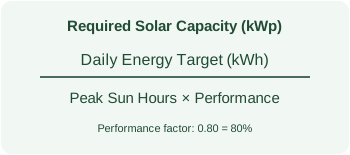
For a household consuming 15kWh per day:
15 ÷ (4.5 × 0.80) = approximately 4.17kWp.
This means a solar array with roughly 4.17kWp of rated capacity could produce an amount of electricity comparable to the household’s average daily consumption under the assumed conditions.
However, matching average daily energy generation does not guarantee complete independence from the grid.
Step 5: Calculate how many solar panels you need
Once you know the required array capacity, divide it by the rated wattage of your chosen solar panels.

Using 550W solar panels:
4,170 ÷ 550 = approximately 7.58 panels.
Round up to eight panels.
Eight 550W panels provide:
8 × 550W = 4,400W, or 4.4kWp.
Under the assumed 4.5 peak sun hours and 80% performance factor, this array could generate approximately 15.84kWh on an average modeled day.
Actual generation will vary.
Solar panel requirements by monthly electricity consumption
The following estimates use 550W panels, 4.5 peak sun hours per day, 80% overall performance, and a 30-day month.
| Monthly electricity use | Approximate panels | Array capacity |
|---|---|---|
| 150kWh | 3 | 1.65kWp |
| 250kWh | 5 | 2.75kWp |
| 350kWh | 6 | 3.30kWp |
| 450kWh | 8 | 4.40kWp |
| 600kWh | 11 | 6.05kWp |
| 800kWh | 14 | 7.70kWp |
| 1,000kWh | 17 | 9.35kWp |
These estimates compare average solar production with household consumption. They do not account for electricity exported to the grid, battery charging losses, or the timing of household electricity usage.
For grid-connected systems without batteries, solar electricity generated when household demand is low may not offset nighttime electricity use directly.
How many solar panels fit on your roof?
Roof area is another important consideration.
A modern 550W solar panel may occupy approximately 2.3 to 2.6 square meters, depending on the manufacturer and model.
Using 2.5 square meters per panel as an example:
| Number of panels | Approximate panel footprint |
|---|---|
| 4 | 10m² |
| 6 | 15m² |
| 8 | 20m² |
| 10 | 25m² |
| 15 | 37.5m² |
| 20 | 50m² |
Actual installation area may be greater because of roof edges, access requirements, obstructions, mounting geometry, and maintenance clearances.
Roof structure, waterproofing, wind loads, and mounting attachment requirements should be assessed before installation.
This is particularly important in Philippine locations exposed to strong typhoons.
Can solar panels power an air conditioner?
Yes. Solar panels can supply electricity for an air conditioner through a compatible inverter.
Suppose a 1HP inverter air conditioner averages 800W and operates for eight hours.
Its estimated energy consumption would be:
800W × 8 hours = 6.4kWh.
Using our assumptions:
6.4 ÷ (4.5 × 0.80) = approximately 1.78kWp.
Four 550W panels provide 2.2kWp, which could generate enough total daily energy to match that consumption under favorable average conditions.
However, four panels do not guarantee eight continuous hours of air conditioner operation. Solar output changes throughout the day, and batteries or grid power may be needed when generation falls below demand.
Do you need batteries with solar panels?
Not always.
A grid-connected solar installation may operate without batteries, depending on the inverter and system configuration.
Batteries become useful when you want to store excess solar energy, operate appliances at night using stored electricity, or maintain backup power during brownouts.
For off-grid installations, sufficient battery storage is typically essential.
Battery sizing should be based on the amount of energy required during periods without solar production.
For example, a household needing 5kWh of usable AC energy would require approximately 6.17kWh of nominal battery storage when assuming 90% usable DoD and 90% conversion efficiency.
See how to calculate solar battery capacity for your home for the complete sizing method.
Which solar inverter should you use?
The inverter must be compatible with the solar array and the household’s electrical requirements.
A 3kW inverter may be suitable for smaller simultaneous household loads, while a 5kW inverter offers additional AC output capacity.
However, the inverter’s AC rating does not necessarily equal its maximum supported PV array capacity.
Before choosing equipment, check the manufacturer’s specifications for maximum PV power, MPPT voltage range, maximum PV open-circuit voltage, PV input current, and any battery requirements.
For a comparison, read 3kW vs 5kW Solar Inverter: Which Size Do You Need?
How much can solar panels reduce your electricity bill?
Electricity savings depend on how much solar electricity replaces grid electricity and the rate charged by your distribution utility.
For example, if your solar system directly offsets 300kWh of electricity that would otherwise cost ₱11 per kWh, the illustrative monthly avoided energy cost would be:
300 × ₱11 = ₱3,300.
This is not a guaranteed bill reduction. Actual savings depend on tariff components, system generation, self-consumption, exported electricity credits, and other billing rules.
A system that produces more electricity than the household consumes during daylight hours may require net metering or battery storage to obtain additional value from excess generation.
Frequently asked questions
How many solar panels are needed for a 3kW system?
With 550W panels, six panels provide 3.3kWp of rated solar capacity. Whether this configuration is suitable depends on the inverter’s PV input specifications.
Can five solar panels power a house?
Five 550W panels provide 2.75kWp of rated capacity. This may offset a meaningful portion of electricity consumption in a small household, but it may not supply all household needs.
How many solar panels are needed for a house using 500kWh per month?
Under the example assumptions, approximately nine 550W panels would provide enough modeled average daily energy to match 500kWh per month. Actual system sizing should account for usage patterns and site conditions.
Do solar panels work during rainy weather?
Yes, solar panels can still produce electricity under cloudy or rainy conditions, but output is generally lower than during clear, sunny weather.
Can solar panels power a house during a brownout?
Only if the system is designed for backup or off-grid operation. Standard grid-tied systems without suitable backup capability normally shut down during utility outages.
Is a bigger solar panel always better?
Not necessarily. Higher-wattage panels can reduce the number of modules required, but physical dimensions, efficiency, roof layout, inverter compatibility, warranty, and installation costs should also be considered.
Final verdict
The number of solar panels needed for a Philippine home depends primarily on electricity consumption, available sunlight, and system performance.
For a household consuming around 450kWh per month, eight 550W solar panels provide a reasonable preliminary estimate under the assumptions used in this guide.
However, final system sizing should also account for roof conditions, inverter compatibility, appliance usage patterns, and whether battery backup or grid export is required.
Start with your actual electricity bills, estimate the required solar generation, and select equipment that meets your household’s needs without unnecessary oversizing.
Continue with our solar panel calculator, 450W and 550W panel comparison, solar installation cost guide. Use the examples to compare assumptions before requesting a site-specific design.
For background on rooftop suitability, system planning, and choosing an installer, see the U.S. Department of Energy’s Homeowner’s Guide to Solar. It covers general planning principles; Philippine tariffs and utility requirements differ.